MAY ALL BEINGS BE FREE FROM SUFFERING

Poisoned
Cruelty, speciesism, narcissism, apathy, ignorance – just what is a useful explanation for the use of rodenticide?
PLANTS ON PURPOSE
Allie
6/17/20265 min read
Humans have to protect animals from other humans. It’s a war, and I fight my battle where I live in the Mojave Desert.
Some people here go to war with nature. They come in thinking they own the place. I mean, they bought the land, bulldozed it bare of that boring brown scrub, the seemingly desiccated skeletons, the villain cactus with their evil glochids. Centuries of desert crust, the living skins of cyanobacteria, mycorrhizal mycelium and moss, scraped away.
Original wildlife habitat is forever destroyed, its indigenous residents pushed out to clear the way for cement and impossibly obstructive structures that have no business being there, creating dangers and adding poisons – sometimes without knowing, and sometimes on purpose.
Human interlopers, to please themselves, have removed the animals’ food source, their shelter and their living space. And humans get really pissed off when those animals show up inside their people mansions. Rats in your cabinets? Squirrels in your garage? Something chewing wires, eating screens, digging holes, holes, holes everywhere? What did you expect?
And even if you are not the developer, residents fleeing the wasted land can end up on your doorstep as well. Got trash cans overflowing? Dumpsters left open? Do you put out feed or water for birds in your yard? Cracks and crevices open to the outside? Knock, knock.
Animals are looking for food and water, safety and comfort – just like us. They had it, but we took it away. The cycle of life within their natural world contained danger aplenty without the plague of people.
And we are plain stupid, too. Instead of caretaking the areas we claim and minimizing our oversized footprints, we actually bait the animals – or pay companies to do it for us — thus guaranteeing a “pest” problem. Stupid.
This is what happens to the little rodent. And many people don’t care because it’s a little rodent. This is who we are talking about, my imperiled neighbors, named: the desert woodrat/packrat (Neotoma lepida), kangaroo rat (Dipodomys merriami), antelope squirrel (Ammospermophilus leucurus), pocket mice (Chaetodipus and Perognathus); house mouse (Mus musculus), roof rat/black rat (Rattus rattus), and Norway rat/brown rat (Rattus norvegicus).
Bromethalin is the poison that replaced anticoagulants – the bleed to death chemicals now illegal for use as rodenticides in California.
Footnote, asterisk, loophole. Because there is always a fucking loophole. The California Ecosystems Protection Act of 2020 still allows the use of anticoagulants for squirrel murders.
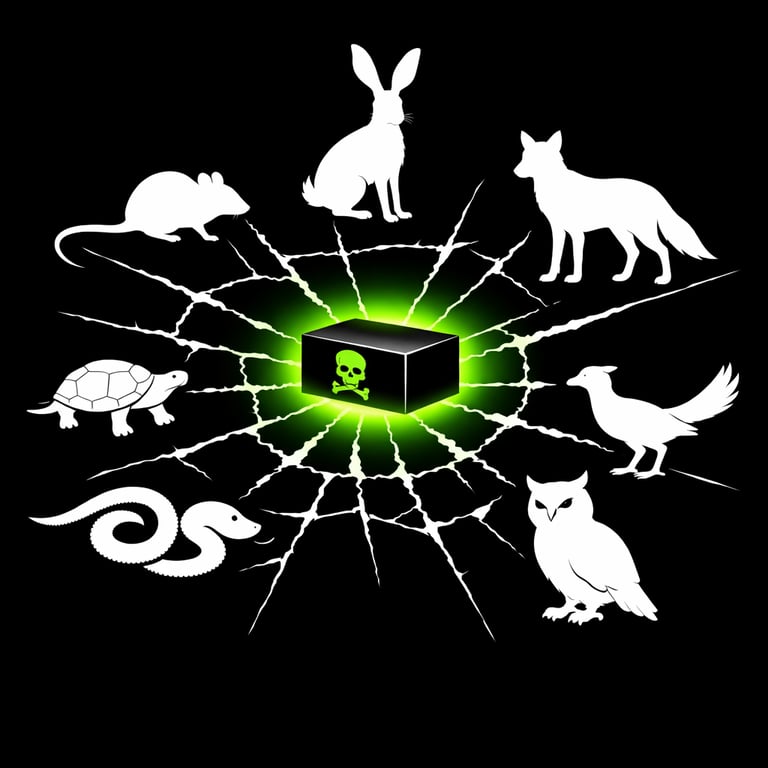
Over the course of a week or so, the California ground squirrel (Otospermophilus beecheyi) will suffer extreme internal hemorrhaging before death. If eaten by a natural apex predator, that hawk, owl, coyote or bobcat – plus everyone in their nest, pack or den – can be secondarily poisoned.
If the squirrel dies and decomposes in his burrow, not only his family but all others using the vast subterranean network, like desert tortoises, burrowing owls, and insects, are in danger.
The “squirrel poison” loophole is of human thinking and making. The instructions on the box say “for mice and rats only,” or “for squirrels.” Do you think the animals are reading this? Once you throw poison into the ecosystem, it’s perceived as food for everyone.
The desert cottontail (Sylvilagus audubonii) and jack rabbit (Lepus californicus deserticola) cannot vomit. Once they eat a toxic pellet, there is no going back; they begin to slowly bleed to death. And because their bodies are larger than squirrels and rats, the toxic payload to predators is larger as well.
Bromethalin (the poison in bait boxes at Home Depot) is a neurotoxin. The animals don’t die right away. They leave the bait box and enter a slow or slower-dying hell.
Rapid fluid buildup creates intense intracranial pressure … the nervous system is fried …violent cramping, seizures, convulsions … hyperthermia … respiratory failure … or, at lower doses, severe abdominal distress … paralysis … bladder and bowel failure … final coma.
Raptors, snakes, coyotes and bobcats fall victim to secondary rodenticide poisoning. They eat what they’ve always eaten, and now it kills them. Perhaps these apex animals are more valued because they’re more visible, they’re bigger. Humans get upset about that? That is speciesism.
Who else suffers from bromethalin? Beetles, ants, flies and the lizards and the birds who eat them. For example, a western fence lizard (Sceloporus occidentalis) poisoned by the bait could kill a coachwhip (Masticophis flagellum) or roadrunner (Geococcyx californianus) who chooses it for dinner.
Ready to go one step further?
Your dog or cat is poisoned. They are most likely to eat the bait directly, since it’s intentionally made with food-grade ingredients like peanut butter and put in brightly colored boxes that might be fun to play with.
Your little kids might think so, too.
I was reminded of all of this when my beautiful neighbor sent word today. In her June newsletter, founder of Save Joshua Tree Wildlife, Navah Raphael, painted this dreadful picture:
“As I do every evening, I looked out across the desert, taking in the landscape I love so deeply. There, at the water bowl I keep outside to support local wildlife — especially during the hot summer months — I saw a coyote.
The sight stopped me cold. My heart sank, and tears immediately filled my eyes. The coyote was unrecognizable. Her tail was as thin as a rat's, her body painfully emaciated, her fur almost completely gone and riddled with mange. She appeared to be suffering from a severe rectal prolapse - her internal organs were pushed out and hanging. It was a level of suffering that no living being should ever have to endure. I felt utterly powerless and couldn't understand how she was even able to put one foot in front of the other.
I rushed outside to follow her, hoping somehow I could help, but she had already disappeared into the desert. Her condition was a direct result of people using rat poisons – she had ingested toxic rats, mice, roadrunners and squirrels. I prayed she would find peace — that she would lie down, fall asleep, and not wake up to another day of pain.
If a pest control company tells you a poison is safe, it simply isn't true. Poison is poison. There are no safe poisons. Many pest control companies use bait boxes excessively, sometimes placing up to seven boxes around a single property. This is unnecessary and catastrophic for the wildlife. Bait boxes don't repel rodents; they attract more.
If rodenticides are being used in your neighborhood, please consider downloading and printing the two diagrams below. Pass a poster on to an Airbnb host or resident who is using poison. Many people have no idea of the devastation these poisons cause. Education is essential for change.
If you are staying at an Airbnb or rental property where poison is being used, please consider speaking to your host respectfully and expressing your concerns for the local wildlife. If they are unresponsive, leave a review. Many hosts are willing to listen and make changes when they understand their guests are affected. Some may not -- but many will.
The wildlife need us to speak up for them.
This message is dedicated to every animal suffering as a result of rodenticides that continue to harm our wildlife communities. If you have a coyote with mange in your neighborhood, please reach out to us. There are ways to help, and together we can make a difference.
With love for the wildlife,
Navah Raphael, Founder
Save Joshua Tree Wildlife”
Save Joshua Tree Wildlife, savejtwildlife.org, is working for a poison-free desert. The website is an educational resource and a call to action. Navah details the animals, the poisons, the problems and the solutions. I am grateful to her and support her mission completely.
How do you change someone’s mind? Is it possible through education and advocacy? Can you teach compassion? That’s a question I keep coming back to in my work. I’m giving it another go by presenting my interactive thought experiment “Somebody/something” next month at a show about selective compassion at the Hi-Desert Artists Art Center.
For now my heart is with Navah’s coyote, praying her release from suffering has come.
What's the situation with poison in your environment? Write and tell me at allie.irwin@gmail.com.