MAY ALL BEINGS BE FREE FROM SUFFERING
Public lands, private greed
Helicopters, wild horses and the cost of consumption
Allie
7/13/20263 min read
I have no first-hand experience. I saw it on the evening news one year while visiting my grandparents in Sarasota. My grandmother must have helped me draft the letter, as the response is addressed to her. I found that envelope. I remember a vague platitude from a staffer in the reply letter, which I can’t find. I remember being knee-deep in ponies and the barn-kid life at the time, but why was I having such a visceral reaction to the roundups? I also had a recurring memory that still echoes, and I’ve never been able to place it in waking life:
A wild horse is carrying me home to safety. I can’t see, only feel the hoof-falls and the mane against my cheek and curled tight in my fingers. I don’t know where we are or where we are going or any other part of the story. It is a felt, known sense. It feels innate.
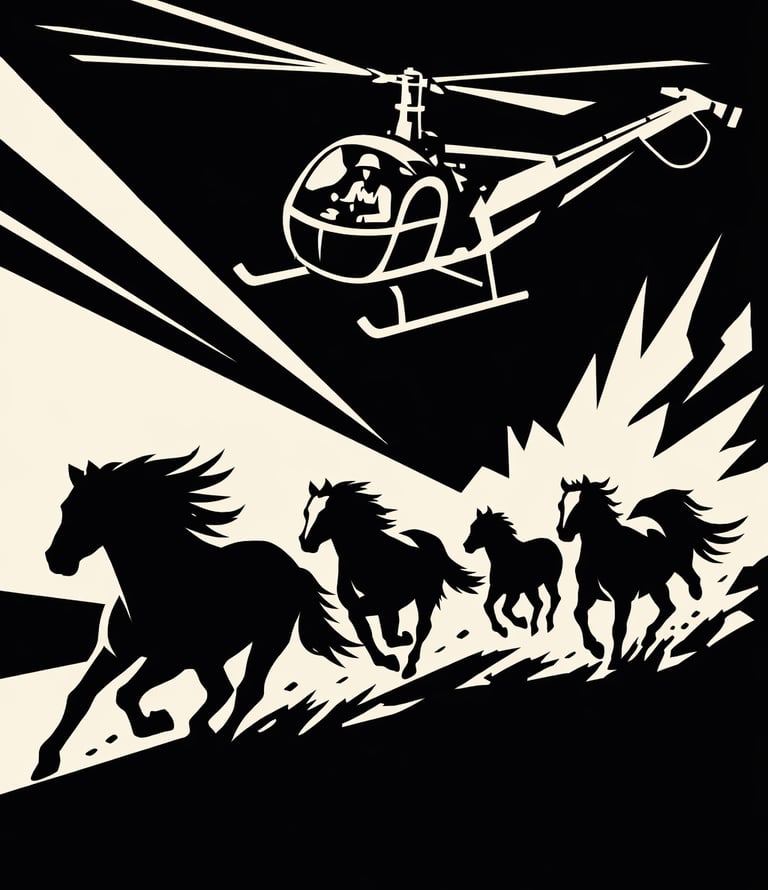
If we didn't eat cows, we wouldn't need to graze cattle -- and the wild horses would not be chased down by helicopters, captured and imprisoned and sent for adoption/slaughter. The "management" of the wild horse population would look much different.
But things look very much the same as they did in 1982, when my 12-year-old self wrote a letter to President Reagan begging him to stop the helicopter roundups.
Ranchers were given preference on public lands long before the Reagan era, though. The U.S. Grazing Service was formed in 1934, and it charged twice as much to graze a horse as it did a cow. Rather than paying for their horses, ranchers let the unbranded one roam unclaimed, essentially disowning them on paper while still benefiting from the land. When the bands of wild horses grew, they were labeled “mavericks.” By law, the ranchers could round up, sell and kill them at will.
An insatiable hunger for beef and wealth requires more and more viable land for grazing cattle. Through overuse and overconsumption of natural resources, natural spaces on public lands are shrinking. In recent decades, the government has set population caps on wild horses in order to protect the beef industry. Horses are driven from their homelands, separated from their families, held in pens for indeterminate periods – sometimes lifetimes – and sold and/or killed so that cattle can graze before they, too, are sold and killed.
I’m not watching the evening news on the lanai with my grandma. The algorithm is hitting me over the head, tearing my heart apart with images and stories and arguments and calls to action.
Advocacy groups are actively mobilizing to combat the federal government's aggressive 2026 roundup schedule – 14,000-plus horses and burros – that seems to have begun with the massive operations currently unfolding here in California and in Nevada. Last week brought a wave of active federal helicopter captures, major tribal protests and courtroom battles.
The most intense active situation is unfolding at Mono Lake, California. A massive federal helicopter roundup kicked off to remove the majority of a herd there. Federal agencies cite trampled wetlands and highway hazards as the reason for the capture. Local Native American tribes, including the Utu Utu Gwaitu Benton Paiute Tribe, fiercely fought the Mono Lake operation, calling the horses sacred relatives and pleading for non-lethal fertility control. Indigenous leaders filed an emergency restraining order to halt the helicopters, but a federal judge denied it and hundreds of horses have already been trapped.
Yes, it’s complicated. Politics, public land management. But you know what’s actually not complicated?
Stop eating animals. Just stop it.
For petitions and action alerts for the 2026 wild horse roundups, you can start here:
American Wild Horse Conservation
Drop me and note and tell me what you think: allie.irwin@gmail.com